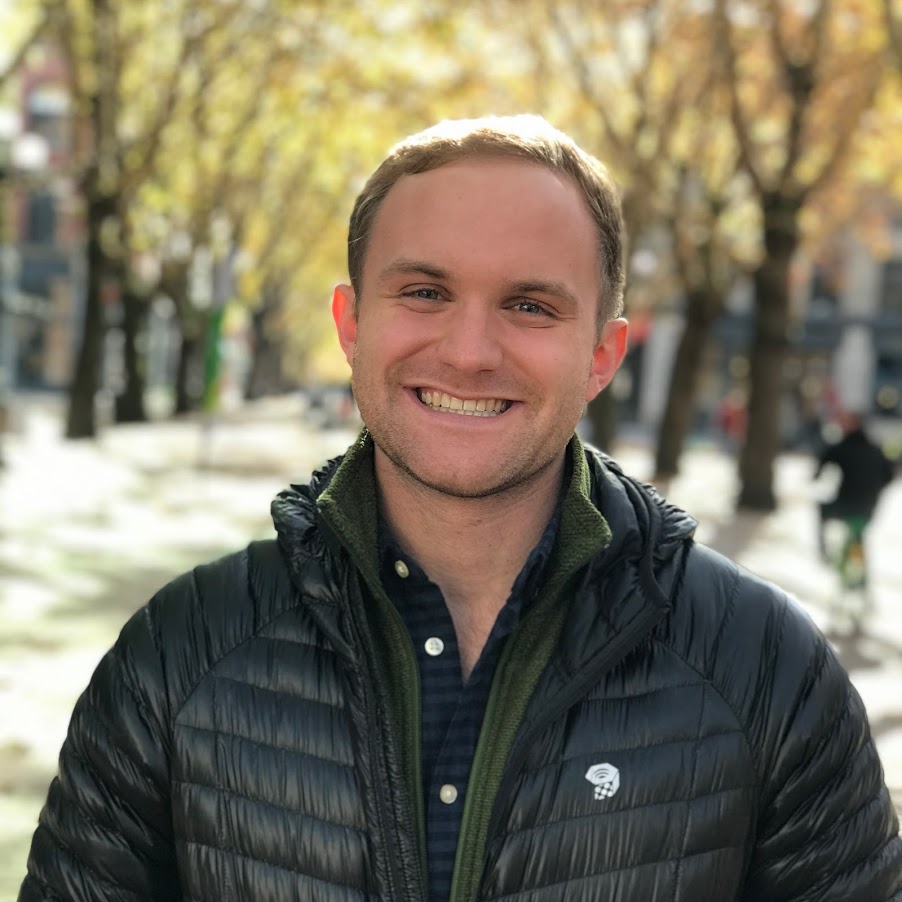
I am a Rubin Postdoctoral Fellow at the Kavli Institute for Particle Astrophysics and Cosmology (KIPAC) at Stanford University and SLAC National Accelerator Laboratory.
I study the large scale structure of the universe to extract information about fundamental physics and our cosmic origins. I am particularly interested in the high-redshift universe and using Lyman-break Galaxies (LBGs) and CMB lensing to constrain cosmology in the matter-dominated era. I created and lead the LBG Topical Team of the Dark Energy Science Collaboration (DESC) of the Vera C. Rubin Observatory's Legacy Survey of Space and Time (LSST). I also work on DESC's weak lensing analysis, particularly on pipelines, simulations, and validation for photo-z estimation and on photometric error modeling for simulated multi-survey catalogs.
I am also a member of the Rubin Observatory's active optics team. The active optics system applies real-time corrections to the telescope's optical alignment and mirror figure to optimize image quality for precision science, and is particularly vital for weak lensing and large-scale structure cosmology. I am primarily focused on wavefront estimation (i.e., inferring the presence of optical aberrations from Rubin images) and commissioning the active optics control system. I have spent many nights on the summit observing with and commissioning the Rubin Observatory.
I received my PhD at the University of Washington, advised by Prof. Andy Connolly. Before that, I completed my undergraduate studies at Duke University, where I was a Duke Faculty Scholar working with Prof. Kate Scholberg in the Duke Neutrino and Cosmology Group.
In my free time I enjoy alpine climbing, backcountry skiing, and watching way too many movies.
Note that I have a double name and go by "John Franklin" or "JF", not just "John".